 Sioux Falls Hood Cleaning
 Exhaust Fan Cleaning & Repair in Sioux Falls
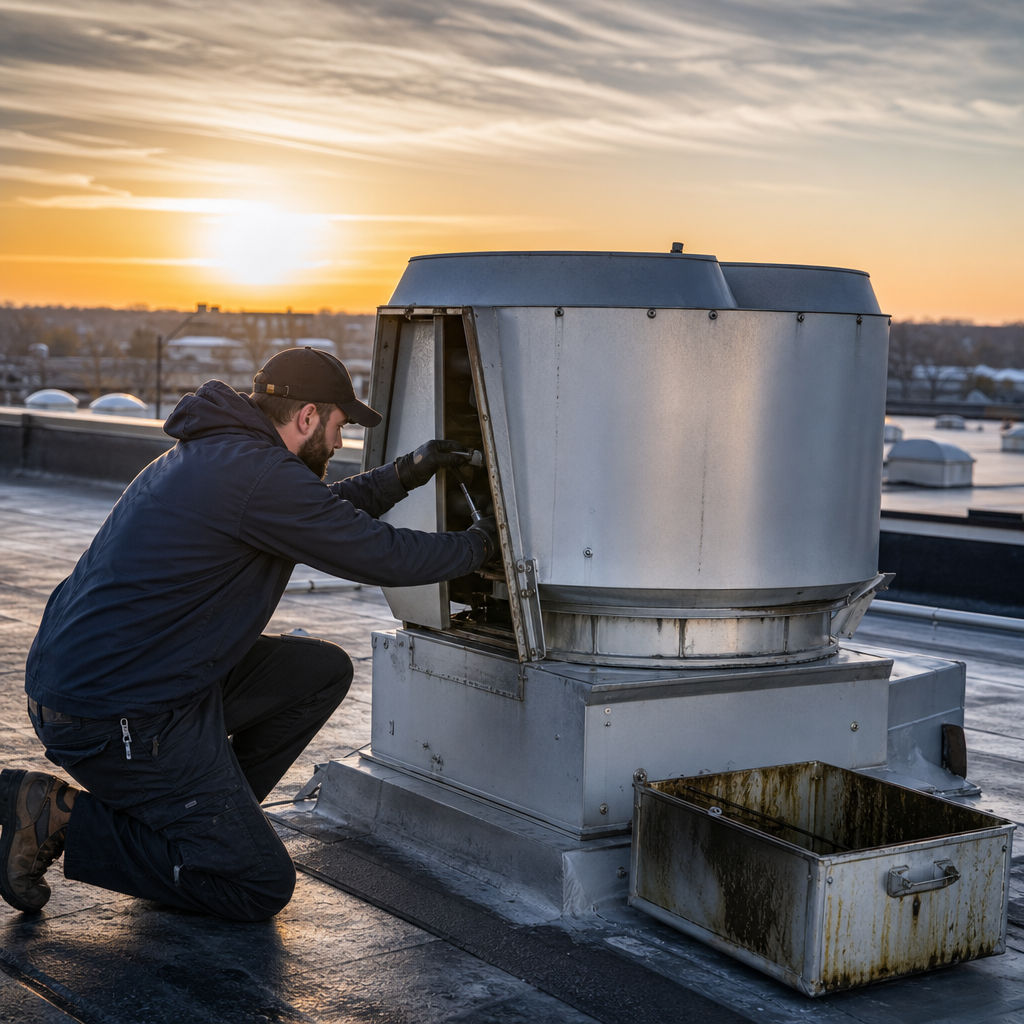
Your rooftop exhaust fan is the workhorse at the end of the grease path, and the component most “hood cleanings” quietly skip because reaching it takes roof access, planning, and someone willing to open it properly. Full fan service in Sioux Falls means degreasing the housing and blades to the bare-metal standard, checking belts and bearings while it’s open, and fixing the access problem permanently with a hinge kit ($150–$300 installed) so the fan never gets skipped again.
What the fan does and why it suffers
Every hour the line runs, the fan pulls grease-laden vapor off your cooking equipment, through the filters and duct, and out of the building. Whatever the baffle filters don’t catch ends up condensing somewhere downstream, and the fan housing is the last stop. Grease builds on the blades and housing walls, gets slung outward by rotation, and drips onto the curb and roof around the unit.
NFPA 96 accounts for exactly this: the cleaning trigger measured with a depth-gauge comb is 0.078 inches on system surfaces but 0.125 inches in fan housings, the standard itself expects fans to load up. A grease-heavy fan also runs out of balance, which eats belts and bearings, drops airflow (your cooks feel it as a smoky, hot line), and shortens the motor’s life. Cleaning the fan isn’t a nice-to-have on top of the hood and duct work; the system isn’t clean until the fan is.
The access problem, and the $150–$300 permanent fix
Here’s the honest mechanics of why fans get skipped. Most fans sit on a curb with the duct terminating underneath. To clean the housing interior and the top of the duct, the fan has to come open or come off. Without a hinge, that means lifting the unit and setting it on the roof: heavy, awkward at 2 a.m., and the classic way wiring gets strained and fan bases get bent. So low-bid crews wipe the outside, leave the inside loaded, and the sticker goes on the hood anyway.
A hinge kit ends that permanently. The fan tips open like a car hood, held safely, with the housing interior and duct top fully exposed. Install runs $150–$300 (parts and labor vary with fan size and curb condition), it’s a one-time cost, and every subsequent cleaning is faster and more complete. If your fan has never been opened during a cleaning, and the before-and-after photos from your last service will tell you, the hinge kit is the first thing worth fixing.
What a fan service visit covers
- Degreasing: housing interior and exterior, blades, and the upper duct section, scraped and washed to the bare-metal endpoint (residual combustible residue no more than 0.002 inches).
- Mechanical check: belt condition and tension, bearing noise and play, mounting hardware, wiring condition. Worn belts are a routine same-visit swap; larger issues get flagged in the report with a plain-language recommendation.
- Grease containment: inspection of any existing containment system, emptying and service of collection media, or a quote to install containment where grease is currently ponding on the roof membrane. A soft, dark ring around the fan base is roof damage in progress, and roof repair costs multiples of containment.
- Documentation: photos of the open fan before and after, noted in the same service report that covers the rest of the system. When a fire inspector or your landlord’s roofing contractor asks about the fan, you have the answer in writing.
Roof access, Sioux Falls edition
Fan work here means planning around real conditions: locked roof hatches nobody can find keys to after close, exterior ladder access on older downtown buildings, and, from November through March, snow and ice on the roof surface. Crews confirm access during the walkthrough, not at 1 a.m., and winter service continues with the footing and staging the conditions require. If your building’s only roof access is a hatch behind the office, tell the scheduler; it changes the plan, not the price band.
Where fan problems show up first
Three symptoms mean the fan needs attention before the schedule says so:
- Smoke hanging at the line: capture velocity has dropped, usually from grease-loaded blades or a slipping belt.
- New noise: squeal on startup is belt; grinding or rumble is bearings. Both are cheaper this month than next month.
- Grease staining down the fascia or around the curb: containment is absent or full, and the roof is paying for it.
Any of these on a system that’s otherwise on schedule is worth a standalone fan visit rather than waiting for the next full cleaning, and if the full system is overdue anyway, one overnight covers both. Fan condition is also one of the things a pre-inspection compliance check looks at, since an inspector on the roof sees the fan first.
Pricing and booking
Fan degreasing is included in every full-system cleaning ($300–$700 typical for a single-hood system, see the pricing page for the complete table). Hinge kits install for $150–$300; belt swaps and containment service are quoted flat during the walkthrough. Whether the kitchen is downtown, on the 41st Street corridor, or out in Harrisburg or Dell Rapids, the visit is scheduled overnight and the fan photos land in your report by morning. Call (605) 675-7391 or send the form for a free walkthrough, and if you’re not sure whether your fan has ever actually been opened, that’s the first thing we’ll check.
Frequently Asked Questions
Why does the rooftop fan need its own attention?
The fan is the end of the grease path, vapor that makes it past the filters and duct condenses in the fan housing and slings onto the blades and the roof around it. NFPA 96's cleaning trigger is actually more tolerant in fan housings (0.125 inches versus 0.078 on other surfaces) precisely because they load up fast, and a grease-heavy fan also runs out of balance, chews belts, and moves less air.
What is a hinge kit and why do crews keep recommending one?
A hinge kit attaches the fan to its curb on a hinge so it tips open for cleaning instead of being lifted off and set on the roof. It protects the fan base and wiring from damage, makes the fan interior and duct top fully accessible every visit, and installs for $150–$300. Once it's on, every future cleaning is faster and more complete.
Can you fix a squealing or slipping fan during the cleaning visit?
Belts and bearings get checked whenever the fan is open, and worn belts are a routine same-visit swap. Bigger repairs (failing bearings, motor issues) get flagged in the service report with a straight recommendation, so you can schedule the fix before the fan quits on a Friday night.
What is grease containment and do we need it?
A containment system catches the grease a working fan throws off before it ponds on the roof membrane. If there's a dark, soft ring around your fan base, the roof is absorbing what containment should be catching, and roof damage costs more than containment. It also keeps the mess from becoming a slip hazard for anyone working up there.
Is fan service included in a hood cleaning or is it separate?
Degreasing the fan is part of every full-system hood cleaning, the system isn't clean to bare metal if the fan isn't. Repairs, hinge-kit installs, and containment systems are separate line items, quoted up front, usually done during the same overnight visit.