 Sioux Falls Hood Cleaning
 Restaurant Hood & Duct Cleaning in Sioux Falls
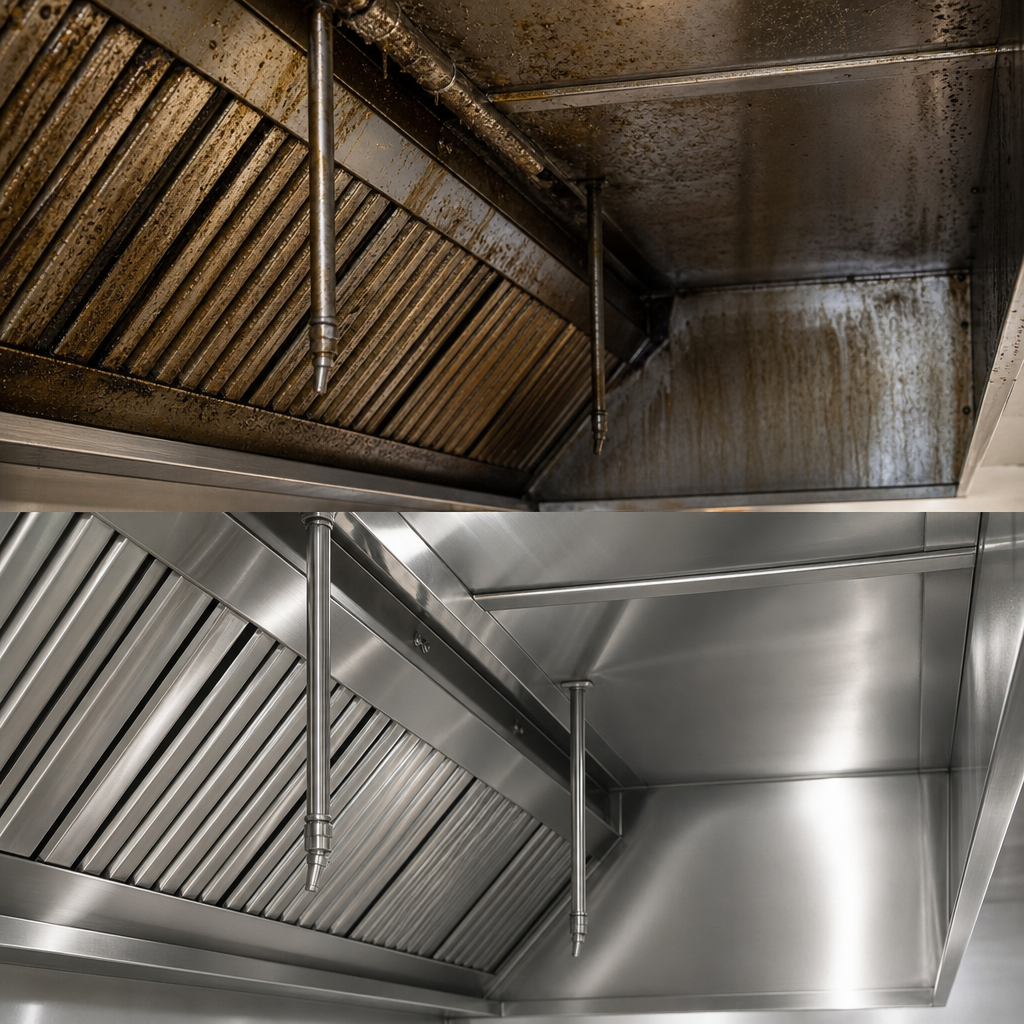
Restaurant hood cleaning in Sioux Falls means cleaning the entire kitchen exhaust system (hood canopy, baffle filters, plenum, ductwork, and rooftop fan) to the NFPA 96 bare-metal standard, on the schedule the city’s adopted fire code sets for your cooking volume. A single-hood system typically runs $300–$700 per service, the work happens overnight after close, and it ends with before-and-after photos, a service report, and a dated sticker on the hood. That full-path scope is the entire difference between compliance and a wipe-down.
Why the duct matters more than the canopy
The part of your exhaust system you can see, the stainless canopy over the cookline, is the part that matters least. Grease-laden vapor rises off the fryers and broilers, passes through the baffle filters (which catch some of it), and condenses on every surface beyond: the plenum first, then the interior of the duct as the air climbs toward the roof, then the fan housing where it slings against the walls. That hidden accumulation is the fuel path. A flare-up on the line becomes a building fire by riding the grease in the duct, the one part a cheap “hood cleaning” never touches.
That’s why NFPA 96, pulled into force here by the 2021 International Fire Code the city adopts through Chapter 91 (kitchen exhaust under IFC §606, cleaning method per ANSI/IKECA C10), treats the system as one continuous grease path. And it’s why the photos matter: the canopy always looks clean in the after shot. The duct interior is where the honest companies separate from the rest.
What the schedule actually is
NFPA 96 (2024) Table 12.4 sets inspection frequency by cooking operation:
| Cooking operation | Inspection frequency |
|---|---|
| Solid-fuel cooking | Monthly |
| High-volume (24-hour, charbroiling, wok) | Quarterly |
| Moderate-volume | Semiannually |
| Low-volume (churches, seasonal, day camps, senior centers) | Annually |
Cleaning is then triggered by what the inspection finds: grease measured with a depth-gauge comb under §12.6.1, with cleaning required at 0.078 inches (2000 microns) on surfaces or 0.125 inches in fan housings. In practice a charbroiler-heavy Sioux Falls kitchen hits the trigger about quarterly, the industry shorthand “quarterly hood cleaning” exists because the inspect-then-clean loop lands there for high-volume lines. The full framework, including which category your menu puts you in, is on the NFPA 96 compliance page.
The service, step by step
1. Protection. Cooklines, equipment, and floors get sheeted in plastic; anything that shouldn’t get wet gets covered or moved. The crew works from the kitchen and the roof at the same time.
2. Filters out. Baffle filters come down and get soaked, scraped, and washed, or flagged for replacement if they’re bent, corroded, or burned through. Kitchens that want to skip filter labor entirely put them on a scheduled filter exchange.
3. Plenum and canopy. The chamber behind the filters is where grease concentrates first; it gets scraped and hot-water washed, then the canopy interior and exterior.
4. The duct. Access panels open (their absence gets documented: a duct without access can’t be fully cleaned, and the report will say so honestly), and the vertical and horizontal runs get scraped and washed to bare metal. On downtown buildings where the duct climbs multiple stories, this is most of the job.
5. The fan. On the roof, the fan opens (on a hinge kit if one is installed, which is the right way) and the housing, blades, and grease-containment area get degreased. Belts and bearings get a look while it’s open; anything wearing gets flagged. Fan repair, hinge-kit installs, and containment systems are their own service: exhaust fan cleaning and repair.
6. Rinse, dry, reset. Wash water is captured and disposed of properly. It does not go down your floor drain to become your grease trap’s problem. The kitchen is dried, equipment uncovered, and the line reset for morning.
7. Paperwork. Before-and-after photos of every section including the duct interior and fan, a written service report noting anything that needs attention (missing access panels, worn belts, damaged filters), and a dated certification sticker on the hood.
What it costs
| Configuration | Typical price |
|---|---|
| Small single hood, short duct run | $200–$450 |
| Standard single-hood system | $300–$700 |
| Large or complex single system | to $800+ |
| Multi-hood line (2–4 hoods) | $800–$1,500 |
| Solid-fuel or heavy 24-hour system | high end, monthly/quarterly cadence |
| Rush / pre-inspection service | 25–50% premium |
Hood count, duct run length, roof access, and grease load are what move the number. A free walkthrough turns the range into a firm quote, and the pricing page explains every driver in detail.
Who does the work
South Dakota has no state license for hood cleaners, so the governing requirement is NFPA 96’s: properly trained, qualified, and certified persons acceptable to the authority having jurisdiction, in Sioux Falls, that authority is Sioux Falls Fire Rescue. The industry credentials are IKECA’s CECS, CECT, and CESI. Sioux Falls Hood Cleaning connects your kitchen with certified, insured local companies that carry those credentials; we don’t hold certification ourselves and no one can promise what an inspector concludes. What the service delivers is a system at the standard and the paper trail proving it.
Booking it
Whether you’re a Phillips Avenue dining room with a three-story duct run, a 41st Street franchise with a standard single hood, or a kitchen out in Brandon or Tea, the walkthrough is free: hood count, duct run, roof access, cooking volume, firm quote. Call (605) 675-7391 or send the form, overnight slots book out, and the standing-schedule kitchens get first pick of them.
Frequently Asked Questions
What exactly gets cleaned in a full hood cleaning?
Everything grease touches: the hood canopy, baffle filters, the plenum behind them, the ductwork all the way to the roof, and the exhaust fan itself. The endpoint is the NFPA 96 bare-metal standard, no more than 0.002 inches of residual combustible material anywhere in the system. Anything less than the full path is a partial service, whatever the invoice calls it.
How long does the service take and when does it happen?
Overnight, after close. A single-hood system with a short duct run takes a few hours; multi-hood lines and multi-story duct runs can use the full overnight window. The kitchen is protected during the work and dry and reset before morning prep.
How much does a hood cleaning cost in Sioux Falls?
A single-hood system typically runs $300–$700 per service, small hoods $200–$450, large or complex systems to $800+. Multi-hood lines (2–4 hoods) run $800–$1,500. Duct run length, roof access, and grease load move the number; the walkthrough quote is free and firm.
What do we get as proof the work was done?
Before-and-after photos including the duct interior and fan, a written service report, and a dated certification sticker on the hood. That package is what a fire inspector asks to see and what an insurance carrier requests after an incident.
Our system hasn't been cleaned in over a year. Is that a problem for the first service?
It's a longer first service, honestly priced as one, hardened grease takes more hours to scrape to bare metal. After the catch-up clean, a standing schedule matched to your cooking volume keeps every future visit at standard pricing. No lectures; every kitchen has been there.